


When a business needs to send goods overseas quickly, air freight is often one of the first options to consider. It is useful for urgent orders, valuable products, spare parts and shipments that cannot wait for a longer sea freight journey.
But when you request an air freight quotation, you may notice something confusing: the price is not always based on how much your cargo weighs on a scale.
Airlines and freight providers also consider the space your shipment occupies. This is why two shipments with the same actual weight can have different freight charges.
Understanding how air freight costs are calculated helps businesses plan their shipping budgets, compare quotations and avoid unexpected expenses.
1. Actual Weight vs Volumetric Weight
Understanding the difference between actual weight and volumetric weight is a key step in calculating air freight charges.
Actual weight refers to the physical weight of your cargo, measured in kilograms.
Whereas volumetric weight, or dimensional weight, assesses how large the shipment is in the air.
For instance, a large package that weighs very little occupies a great deal of space inside an aircraft.
Let us consider two packages sent by a company in Dubai, where one contains compact metal parts and the other lightweight plastic packaging. Even if they both weigh 20 kg, the second one uses a lot more space than the first.
Charging both shipments by actual weight alone can be misleading.
2. How Is Volumetric Weight Calculated?
For many international air freight shipments, the volumetric weight is calculated using the package dimensions.
A commonly used formula is:
Volumetric weight (kg) = Length × Width × Height (cm) ÷ 6,000
However, the divisor can vary depending on the carrier, service and agreement. Always confirm the calculation method with your freight provider.
Let’s look at a practical example.
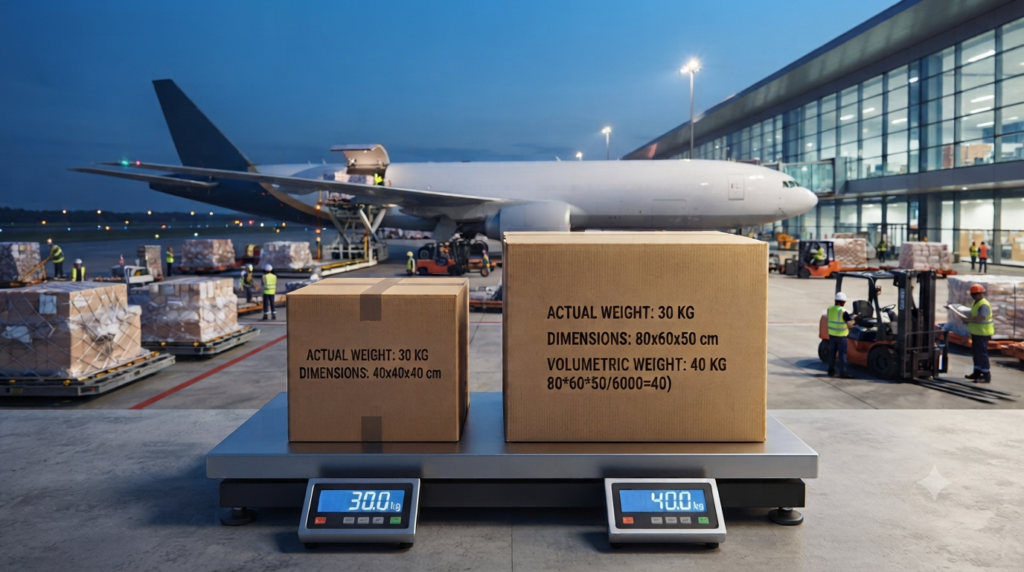
A shipment has the following dimensions:
- Length: 80 cm
- Width: 60 cm
- Height: 50 cm
- Actual weight: 30 kg
The calculation is:
80 × 60 × 50 ÷ 6,000 = 40 kg volumetric weight
Although the shipment physically weighs 30 kg, its volumetric weight is 40 kg.
If the applicable carrier uses this formula, the shipment’s chargeable weight would generally be 40 kg, subject to the carrier’s rules and any rounding requirements.
3. What Is Chargeable Weight?
Chargeable weight is the weight used to calculate the air freight charge. It is generally the higher of the actual weight and volumetric weight.
| Actual Weight | Volumetric Weight | Typical Chargeable Weight |
|---|---|---|
| 25 kg | 18 kg | 25 kg |
| 30 kg | 40 kg | 40 kg |
| 100 kg | 100 kg | 100 kg |
This is one of the most important factors to check when reviewing an air freight quotation.
If your shipment is heavy but compact, actual weight may determine the charge. If it is large and lightweight, volumetric weight may be higher.
4. What Other Factors Affect Air Freight Costs?
Chargeable weight is important, but it is not the only factor that determines the final price.
Destination and route: Shipping from Dubai to a nearby regional destination may cost differently from shipping to Europe, North America or a location with fewer direct cargo connections.
Type of goods: Dangerous goods, temperature-sensitive products, fragile items and certain regulated products may require special handling, packaging or documentation.
Delivery speed: Express services may cost more than standard air freight options.
Fuel and security charges: These may be included in the quotation or listed separately, depending on the carrier and service.
Collection and delivery: Transport from your warehouse to the airport, and from the destination airport to the receiver, can add to the overall cost.
Customs clearance: Brokerage fees, duties and applicable taxes may also affect the total amount you pay, although they are not necessarily part of the air freight rate itself.
For this reason, it is better to compare the complete service cost rather than choosing a provider based only on the lowest advertised rate.
5. Why a Detailed Air Freight Quote Matters
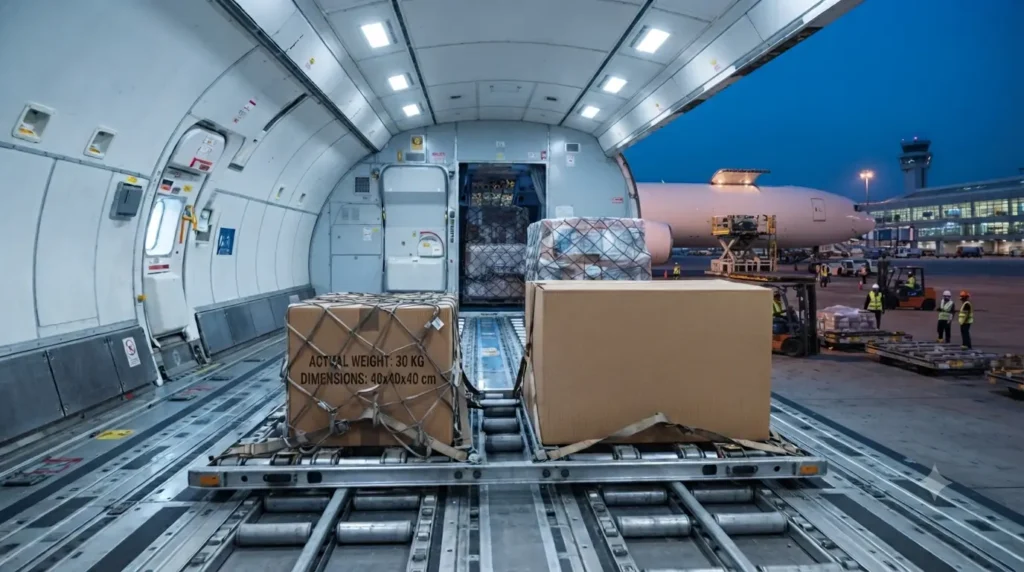
A clear quotation should explain how the chargeable weight was calculated and identify the main services included in the price.
It is important to provide the freight forwarding company with the necessary details of your cargo package before confirming your shipment. Ensure you provide the correct package weight, cargo description, its starting and ending points, as well as any special requirements for handling and delivery.
This will help the provider to evaluate the shipment precisely and minimise the possibility of remaining surprises later on.
How SafeBox Logistics Can Help
SafeBox Logistics provide air freight, sea freight, road transport, freight forwarding and customs clearance to businesses.
If you’re shipping commercial goods out of Dubai to an international destination, the team can assist you with the logistics and the information you’ll need to get a quote.
Final Thoughts
Air freight rates are not only based on the actual weight. The rate depends on many different factors, including the chargeable weight, shipping route, type of cargo, speed of service, and any handling requirements.
Before making a booking, it is essential to check the volumetric weight formula, clarify all charges applied, and ensure that shipment details are correct. Good preparation can help eliminate confusion from the pricing structure of air freight and help a business with the selection of the best delivery option.
If timely international delivery is needed, working with a reliable logistics partner will streamline the process and make it more manageable.